
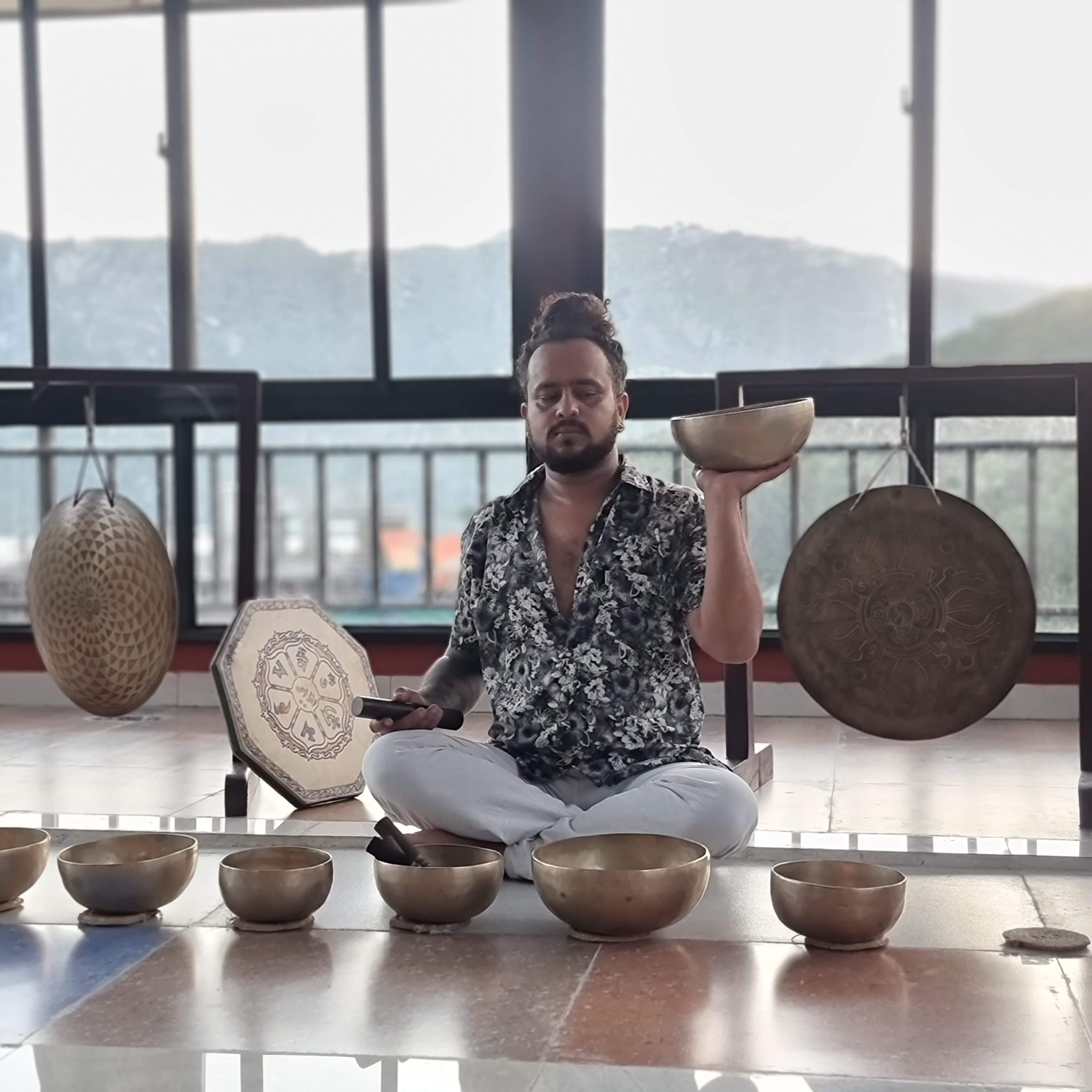
Sapkota is a Nepal based sound healer, meditation facilitator, Ayurveda consultant and wellness educator. His work brings together Himalayan singing bowls, mindful breathing, meditation, Ayurvedic lifestyle guidance, herbal practices and community based learning. Rather than presenting these as disconnected techniques, he approaches them as complementary elements of a more conscious daily life.
Through private sessions, retreats, educational programs, festivals and institutional collaborations, he works with individuals and groups seeking calm, awareness and a more balanced relationship with themselves.
A Foundation in Ayurveda and Sanskrit Learning
Kshitiz Sapkota’s professional path is grounded in the study of traditional knowledge. He studied at Nepal Sanskrit University, where his learning included Sanskrit, Ayurveda and traditional approaches to health and healing.
Sanskrit learning is important within this field because many foundational Ayurvedic ideas and classical texts were originally expressed in the language. This educational background provided Sapkota with a framework for understanding wellbeing through food, habits, environment, individual constitution and daily rhythm.
He later received professional training in Himalayan Singing Bowl Therapy from the Himalayan Yoga Academy. This introduced another dimension to his practice: the use of sound and vibration to support relaxation, mindful attention and meditative experience.
His work today reflects the meeting of these disciplines. Ayurveda offers a framework for daily living, while sound, breath and meditation create experiential ways for people to become more attentive to their mental and physical state.
Why Kshitiz Sapkota Is Known as Baba Jolly
The name Baba Jolly communicates both the spiritual character of Sapkota’s work and his approachable personality. His public identity does not rely on creating distance between the practitioner and the participant. It reflects warmth, openness and the belief that wellness practices should feel welcoming rather than intimidating.
This approach is especially relevant at a time when many people are interested in meditation and traditional healing but may feel uncertain about where to begin. Sapkota presents these practices in a practical form, allowing participants to experience them without requiring extensive prior knowledge.
Sound Healing as an Experience of Conscious Listening
Sound healing is one of the most visible parts of Baba Jolly’s work. His sessions may include Himalayan singing bowls, guided meditation, breath awareness and carefully created periods of silence.
In this setting, sound is not treated simply as performance or entertainment. It becomes a focus for conscious listening. Participants are encouraged to notice vibration, breathing, physical sensations and changes in attention as the session develops.
The experience can provide a structured space for rest and inward observation. Sapkota’s role is to guide that experience with sensitivity, helping participants remain present without forcing a particular emotional or spiritual outcome.
His sound healing work can be adapted for private sessions, group programs, yoga communities, retreats, festivals, schools, universities and workplace wellness activities.
Founder and Director of Shristi Ayurveda Research and Training Center
Beyond his individual practice, Kshitiz Sapkota serves as the Founder and Director of Shristi Ayurveda Research and Training Center. Through this role, he contributes to Ayurveda education, wellness research, professional training and community health initiatives.
The center reflects his wider ambition to preserve traditional knowledge while finding responsible ways to communicate it to present day audiences. Education is central to this work. People are encouraged not only to receive a wellness service, but also to understand the habits and principles that may support their everyday wellbeing.
His experience as a researcher and practitioner allows him to engage with wellness from both educational and practical perspectives. This combination gives his work relevance for individuals as well as institutions seeking structured programs.
A Holistic Approach to Modern Wellbeing
Baba Jolly’s philosophy is based on integration. A single sound healing session may offer temporary relaxation, but lasting wellbeing also depends on how a person sleeps, eats, breathes, works and responds to stress.
His Ayurveda consultations therefore focus on lifestyle rhythm, daily habits, food awareness, herbal wellbeing and realistic forms of self care. Meditation and breathwork are introduced as practices that can be incorporated into ordinary life, rather than activities reserved only for spiritual retreats.
He also facilitates herbal tea ceremonies that combine Ayurvedic awareness, mindful conversation and community connection. These gatherings create a slower and more intentional environment in which people can listen, share and experience traditional herbal knowledge.
Working Across Nepal and International Wellness Communities
Kshitiz Sapkota’s work has extended beyond individual consultations. He has participated in retreats, teacher training programs, cultural gatherings, wellness festivals and collaborative events in Nepal, India, China and other international settings.
His programs are suitable for retreat organizers, yoga teachers, educational institutions, companies, festivals and communities interested in culturally rooted wellness experiences. Depending on the setting, he can combine sound healing, guided meditation, breathwork, Ayurveda education and herbal practices into a focused session or a wider retreat program.
This flexibility has helped him communicate Nepal’s living wellness traditions to audiences from different cultural backgrounds while maintaining respect for their original context.
Preserving Tradition Without Freezing It in the Past
One of the defining qualities of Sapkota’s journey is his effort to preserve traditional wisdom without treating it as something distant from modern life. His work asks a relevant question: how can ancient knowledge continue to serve people facing contemporary pressure, distraction and emotional fatigue?
His answer is not to simplify the tradition beyond recognition. Instead, he creates accessible entry points through sound, breathing, meditation, daily routine and conversation.
In doing so, Kshitiz Sapkota is contributing to a growing wellness movement rooted in Nepal’s own knowledge systems. As Baba Jolly, he continues to create spaces where people can experience sound with attention, explore Ayurveda with curiosity and approach wellbeing as a conscious way of living.
Frequently Asked Questions
Who is Kshitiz Sapkota?
Kshitiz Sapkota, professionally known as Baba Jolly, is a Nepali sound healer, meditation facilitator, Ayurveda consultant and wellness educator.
What services does Baba Jolly offer?
His work includes Himalayan singing bowl therapy, sound healing, guided meditation, breathwork, Ayurveda lifestyle guidance, herbal practices, retreats, training programs and wellness collaborations.
Where did Kshitiz Sapkota study?
He studied at Nepal Sanskrit University and received professional Himalayan Singing Bowl Therapy training from the Himalayan Yoga Academy.
How can people book a session?
Private sessions, retreats and institutional collaborations can be explored through the official
Baba Jolly booking page.


